
Alvin and the shipwreck (not that shipwreck)
Alvin is perhaps best known to the public as the sub that first explored the wreck of Titanic. It might come as some surprise, then, that it very rarely dives on shipwrecks.
It’s rare because Alvin goes where the scientific community proposes, and to date that has tended very heavily toward hydrothermal vents, deep-sea corals, cold seeps, and other natural seafloor features. That’s not to say wrecks don’t present any scientific interest whatsoever, as we’ll see, but rather that marine archaeology has not been high on the list of funding priorities.
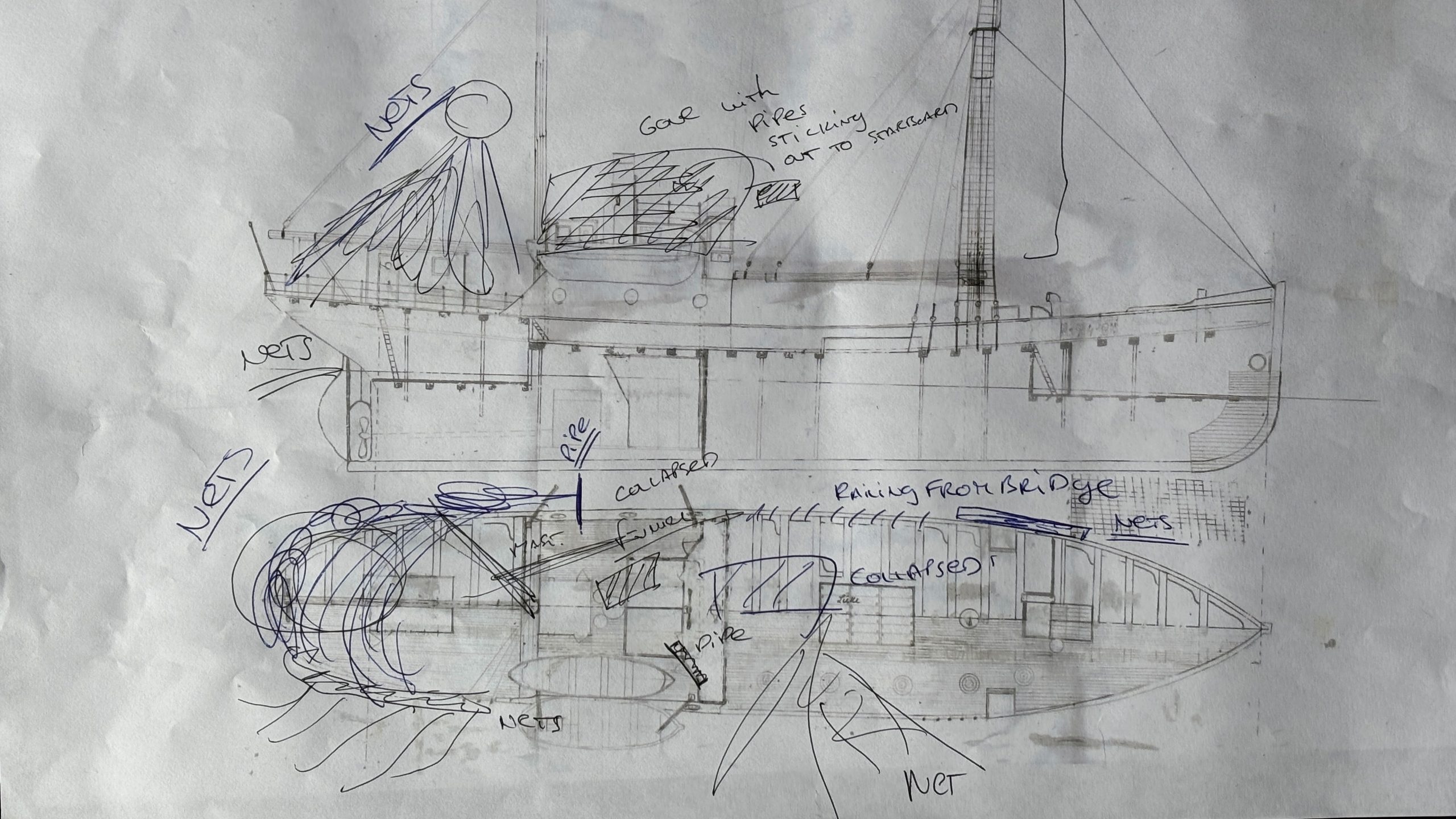
Wrecks also pose significant challenges for the pilots. Some ships have rigging that present entanglement hazards. In addition, many were damaged in sinking or have degraded over time to the point that they no longer resemble their pristine shape. For the people inside Alvin, safety means retiring risk before the sub enters the water, and lack of knowledge about a wreck’s condition presents significant risk.
For that reason, and to begin building high-resolution “digital twins” of the ships, the expedition, which has become known as the Heroic Age Expedition after the Heroic Age of Antarctic Exploration that effectively ended in the early 1900s, also brought a small remotely operated vehicle provided by the NSF-funded Ocean Observatories Initiative, as well as an expert team of three to operate it.
The thing that many wrecks have going for them are stories that link Alvin’s own legacy of exploration and discovery with that earlier era, when large portions of the planet’s landmass, like the depths today, were still unmapped and largely unknown. So when the Royal Canadian Geographical Society approached WHOI about taking Alvin to the Labrador Sea to explore two fabled wrecks, they were met with almost immediate interest.
Quest, a late-1800s exploration vessel once owned by Sir Ernest Shackleton had been sold after the explorer’s death on board in 1922 on South Georgia Island and later found its way north to Canada, where it was converted to a sealing ship. It sank in 1962 off the coast of Labrador with no loss of life. It was found by RCGS after extensive investigative work by Antoine Normandin and an incredibly fortunate (albeit rocky) expedition in 2024 that captured only a few sidescan images of the hull. Since then, it had not been re-visited and had never been seen by human eyes.
The other ship, Terra Nova, was found by a group on the Schmidt Ocean Institute’s original research vessel Falkor during that ship’s shakedown cruise from Europe to North America in 2012. Its discovery was also the result of intense research by Leighton Rolley and support by scientists and technicians from WHOI, University of New Hampshire, and France’s Ifremer. Terra Nova is a much larger vessel than Quest and is well-known as the ship that carried Captain Robert Francis Scott to Antarctica on his ill-fated attempt to reach the South Pole ahead of Norway’s Raold Amundsen.
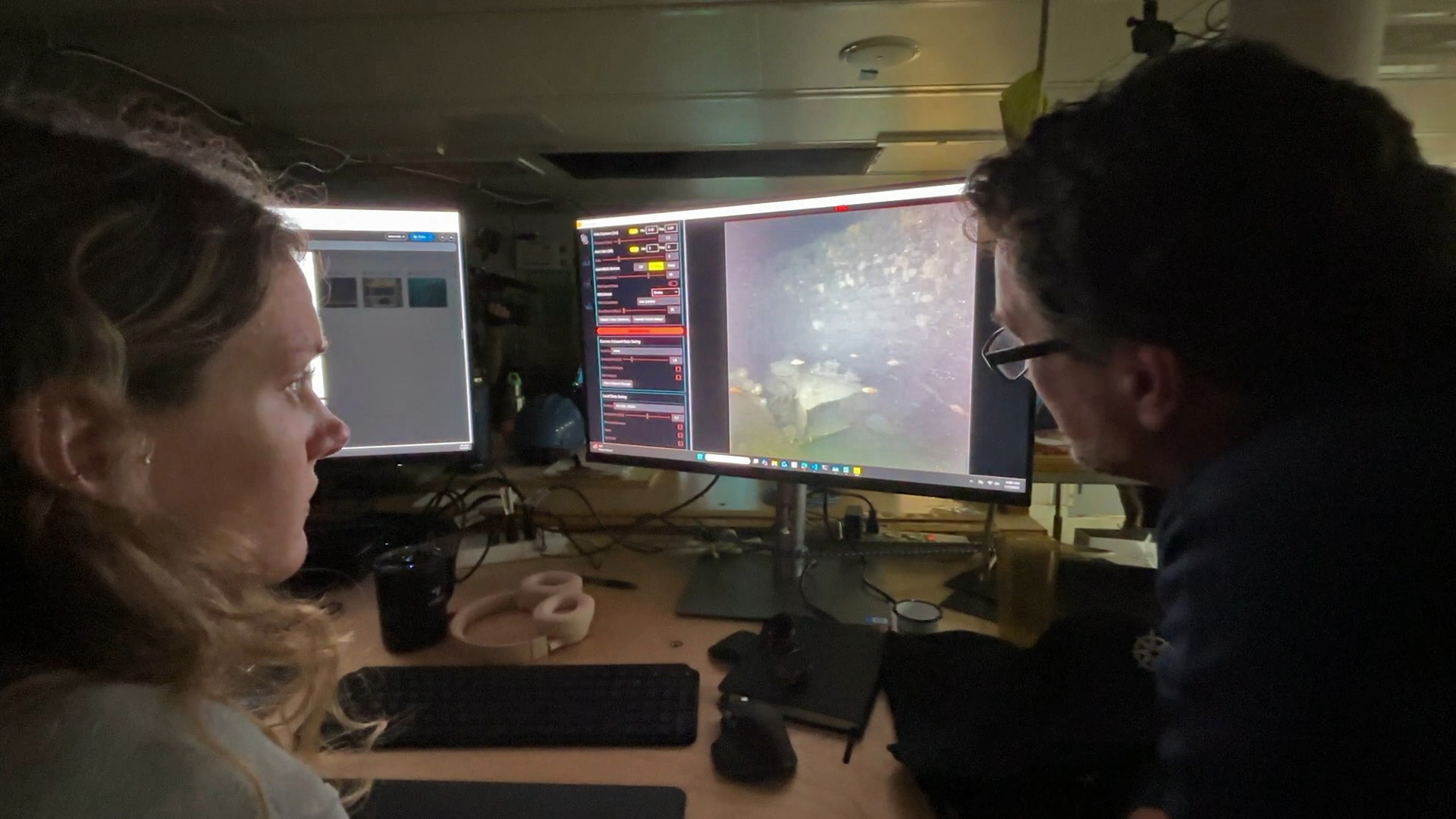
With Alvin recently re-certified to dive to 6500 meters, neither ship presents a challenge in terms of depth (Quest sits at about 400 meters’ depth and Terra Nova at 170 meters), nor is the muddy seafloor around each difficult to navigate. The challenge comes in having sufficient pre-dive intelligence that the pilots feel comfortable in their approach to the wrecks and in navigating the possible jumble of debris on and around them.
Immediately upon arrival at the coordinates provided by RCGS, the ROV went in the water and just as quickly picked up a target on sonar. With nothing else known to be in the area, it had to be Quest—and soon after the bow loomed out of the darkness, its identify was confirmed. A visual survey showed the ship to be covered in soft corals and anemones, surrounded by a constantly moving halo of cod and rockfish, and, in a surprise, partly draped in layers of fishing nets.
That last item made the Alvin pilots take notice. Nets waving in the current could snag the sub or get sucked into thrusters and prevent it from surfacing. Fortunately, it appeared that any hazard could be easily avoided and we began a three-day rhythm of ROV dive in the evening, followed by two half-day “bounce” dives by Alvin between breakfast and dinner.
That rapid cycle of operations has meant twice the number of people has been able to dive in Alvin and see the wreck in person, including WHOI marine biologist Kirstin Meyer-Kaiser, who we’ll hear from in the next post and who already has designs on a meta-analysis of life on wrecks in the North Atlantic. What she's learning could indicate that Alvin’s days supporting marine archeology may not be in the past.